Here’s the thing: the biggest mistake I see brands make is confusing a UGC creator with an influencer. It's an easy trap to fall into, but the difference is night and day.
Let’s boil it down. Influencers are paid for access to their audience, while UGC creators are paid to create authentic content for your audience. One is about renting someone else’s stage; the other is about building a library of high-impact content for your own show.
Welcome to the wild world of digital marketing in 2026. If you're trying to get noticed, you've probably heard two terms thrown around a lot: User-Generated Content (UGC) Creator and Influencer. For brands that want to do more than just exist online, figuring out the difference isn't just a "nice to have"—it's the core of a winning strategy. Picking the right partner means matching your campaign goals to the unique firepower each one brings.

Think of influencers as the digital trendsetters. They’ve spent years building tight-knit communities who hang on their every word. When you team up with an influencer, you're essentially borrowing their platform and the hard-earned trust they have with their followers. It’s a powerful shortcut to credibility.
UGC creators, on the other hand, are the masters of genuine, "real-talk" content. They are specialists at crafting videos, photos, and reviews that look and feel like they came from an actual, happy customer. You buy the content and the rights to use it, then you blast it across your own channels—paid ads, your website, social feeds, you name it.
This whole UGC creator scene has absolutely blown up. We saw the number of people calling themselves UGC creators jump by a staggering 93% between 2024 and 2025. That’s not just a trend; it's a seismic shift. Brands are realizing they need content that looks real because, well, it sells. If you want a deeper dive, our guide on what is a content creator breaks it down even further.
This guide will get into the nitty-gritty of the UGC creator vs influencer debate. We’ll look at everything from who owns the content to what kind of ROI you can expect. It's a classic matchup: aspirational reach vs. raw, sales-driving authenticity. Let’s figure out which one is right for you.
Here’s a quick-and-dirty comparison to get us started:
| Feature | UGC Creator | Influencer |
| Primary Goal | Create content assets for the brand | Distribute content to their own audience |
| Core Value | The quality and authenticity of the content | The size and engagement of their following |
| Content Ownership | Brand typically owns the content outright | Often licensed for a limited campaign period |
| Audience Focus | Brand's target audience | The influencer's established followers |
To really scale your brand, you've got to know when to use each. And to make sure your strategy is firing on all cylinders, a tool like the Trendy app can give you the AI-powered insights needed to nail your content performance. For creators, Trendy offers features like an AI post generator to create engaging captions and an analytics dashboard to track profile growth and see what content resonates most with your audience. You can download it today on the App Store or Google Play.
At first glance, a UGC creator and an influencer might look like they're playing the same game, but they're on entirely different fields with different rulebooks. The core strategic difference in the UGC creator vs influencer debate boils down to a single, critical question: are you buying content or are you renting an audience?
How you answer that question changes everything—your strategy, your budget, and what success actually looks like.
An influencer’s main asset is their distribution channel—their followers. You’re paying a premium to tap into that community and borrow their hard-earned social proof. Think of it like buying a primetime ad slot on a hit TV show; the value is all about the eyeballs.
On the flip side, a UGC creator’s value is the asset itself. You’re commissioning authentic, high-quality content that’s designed to shine on your channels. This is like hiring a brilliant filmmaker to create a commercial you can run wherever and whenever you want. You own it.
The "why" behind hiring each type of creator is fundamentally different. Brands bring influencers on board for amplification and awareness. Their job is to introduce your brand to their audience, using the trust they’ve built to create a positive halo effect around your product.
UGC creators, however, serve a much more direct purpose. They are, in essence, content production specialists hired to build a library of assets for performance marketing. Their work is the fuel for your paid social ads, the social proof on your product pages, and the relatable visuals that make your email campaigns pop and drive real conversions.
Key Takeaway: An influencer's value is their influence over an audience. A UGC creator's value is their ability to produce content that performs for a brand's own marketing efforts.
The creator economy is absolutely booming, with the influencer marketing industry hitting a massive $32.55 billion in 2025. But while the space is growing, the way these creators get paid couldn't be more different. Influencers are compensated based on things like follower counts and engagement rates. UGC creators, however, typically charge a flat fee per deliverable, tying their cost directly to the assets you get to keep. For a deeper look at industry growth, you can explore more influencer marketing statistics.
This is one of the most important distinctions, so pay close attention. When you partner with an influencer, the content they create is almost always theirs. You're usually just licensing the right to have it posted on their feed for a set amount of time. Want to repurpose that killer video for one of your ads? That’ll require a separate, and often pricey, negotiation.
With UGC, the brand nearly always gets full ownership of the content. This is a total game-changer. It means you can edit, chop up, and reuse that video or image across any channel you want—from TikTok ads to your website’s homepage—without asking for permission or paying extra fees. For agile marketing teams that need to test and iterate on creative constantly, this flexibility is gold.
To get a better handle on the different partnership models out there, digging into the nuances between affiliate marketing vs influencer marketing can really help clarify where each strategy fits in your overall plan.
To make this crystal clear, let's break down the fundamental differences between UGC Creators and Influencers in a side-by-side comparison. This table strips away the noise and gets straight to the strategic distinctions that matter for your brand.
| Attribute | UGC Creator | Influencer |
| Primary Goal | Creating authentic content assets for the brand to own and use. | Distributing a brand's message to their own established audience. |
| Core Value | The quality, relatability, and performance of the content. | The size, engagement, and trust of their following. |
| Content Rights | Brand typically receives full ownership and usage rights. | Creator retains ownership; brand licenses usage for a limited time. |
| Key Metrics | Conversion Rate, CTR, CPA, ROAS on the brand's own channels. | Reach, Impressions, Engagement Rate, Follower Growth. |
| Ideal For | Performance marketing, ad creatives, social proof, A/B testing. | Brand awareness, product launches, building credibility. |
Ultimately, knowing these differences is the first step. The next is applying them to your goals and tracking what actually works. A tool like the Trendy app can be invaluable here. Its AI-powered analytics can help any creator or brand understand content performance, generate high-engagement post ideas, and monitor profile growth. By analyzing hard data, you can decide whether a UGC or influencer approach is delivering the goods.
You can download it for free on the App Store or Google Play.
When all is said and done, marketing decisions boil down to one simple question: what’s my return on investment? In the UGC creator vs influencer showdown, the financial and performance numbers tell a really interesting story, especially for brands obsessed with direct-response results and real growth.
Think of it this way: an influencer campaign can feel like a high-stakes gamble on someone else’s audience. UGC, on the other hand, is a much smarter, more sustainable investment in assets you actually own. It's the difference between renting a flashy Lamborghini for a day and buying a reliable, versatile SUV you can use anytime. Sure, both get you from A to B, but only one builds lasting value for your brand.
Let's get right to the money. The price gap between these two creator types can be absolutely massive. Influencers charge based on follower count, engagement metrics, and their industry reputation, which can easily soar into the thousands of dollars for a single post—often with very restrictive usage rights.
UGC creators work differently. They operate on a deliverable-based model. You’re paying for the content itself, not their clout. This makes budgeting a breeze; it's predictable and easy to scale. For the cost of just one post from a mid-tier influencer, you could build a whole library of high-quality, authentic videos and images to fuel your ad campaigns for months.
To really get a grip on the ROI, you first have to know how to measure content performance effectively.
This simple decision tree breaks down the core choice: are you buying access to an audience, or are you buying content assets?
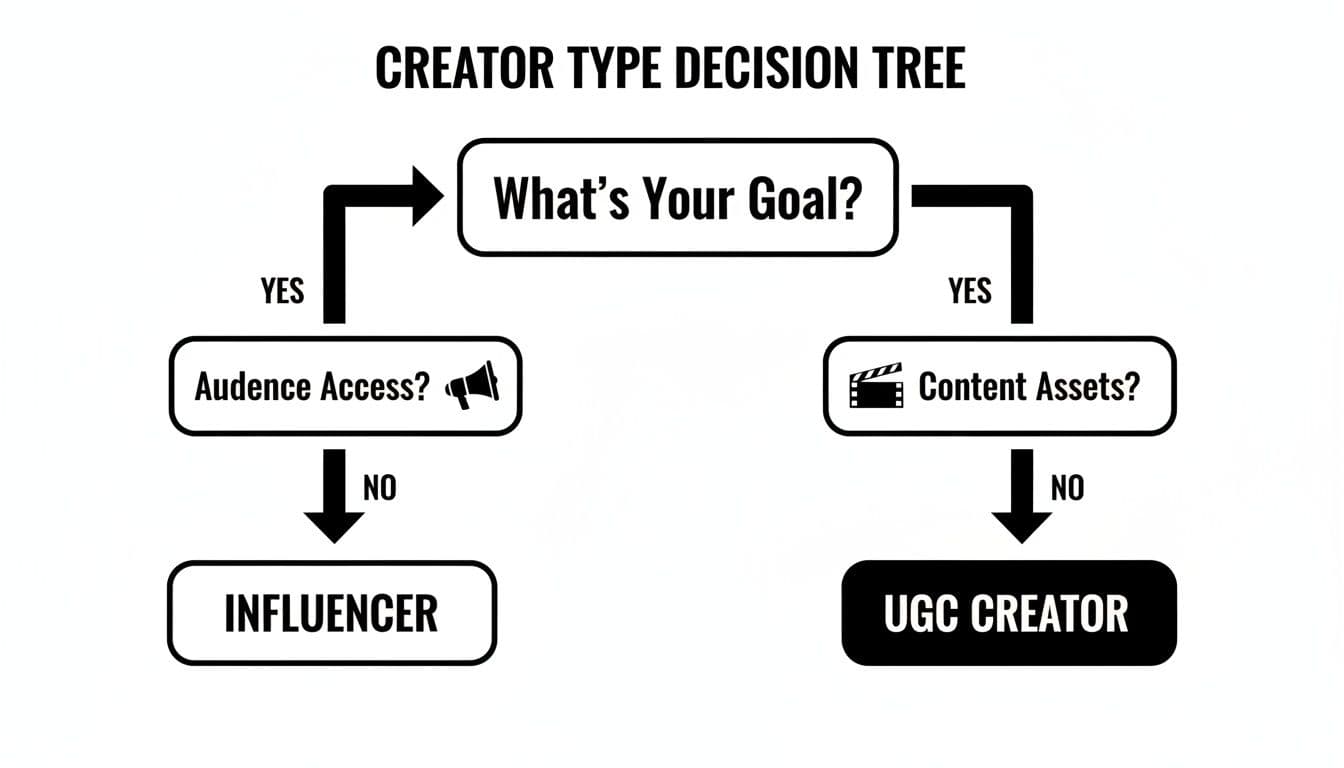
As you can see, if getting in front of a built-in audience is your main goal, an influencer is the way to go. But if you’re trying to build a stockpile of creative, a UGC creator is your best bet.
It's not just about the upfront savings. UGC consistently punches way above its weight when it comes to performance. Because the content looks native—like it came from a real, happy customer—it slips right past the "ad blindness" that so many people have developed for polished, professional brand content. It builds instant trust and social proof exactly where you need it most: at the moment someone is deciding whether to buy.
The data doesn't lie. UGC content consistently blows branded content out of the water while costing 30-80% less than typical influencer marketing. And the engagement numbers are just wild: UGC posts pull in 6.9x more engagement than a brand's own content. Even crazier, social media posts that feature UGC drive a staggering 10.38x higher conversion rates compared to posts created by the brand.
The ROI Equation: Influencer ROI is often gauged by soft metrics like reach and brand awareness. UGC ROI is all about the hard numbers—lower CPAs, higher CTRs, and more sales.
This incredible performance makes UGC an absolute must-have for any brand running paid ads. A constant flow of fresh, authentic creative is the ultimate weapon against ad fatigue, keeping your campaigns running efficiently and profitably over the long haul. For a deeper dive, check out our guide on measuring social media ROI.
At the end of the day, influencers can generate buzz, but UGC creators deliver the assets that directly fuel your growth. To really maximize your returns, you need to know which content is actually working. The Trendy app uses AI to break down your post performance, helping you spot the winning creative and tweak your strategy with data, not guesswork. Its AI-powered analytics and hashtag generator are essential tools for any creator aiming to optimize their ROI. Download Trendy on the App Store or Google Play and start optimizing your content's ROI today.
While UGC is the undisputed champ for getting scalable, high-converting content, you can't ignore the heavy hitters of brand building: influencers. These are the masters of aspiration, social proof, and making a brand famous overnight. Hiring an influencer isn't about getting a few ad assets; it's about renting their spotlight and the years of trust they’ve built with their audience.
This is the move you make when you need to cause a massive ripple effect. Think about a huge product launch, trying to crack a totally new market, or carving out a space for yourself in a super-crowded niche. An influencer partnership is less about immediate sales and more about playing the long game—building up that priceless brand equity.
The real magic of an influencer is rooted in aspirational marketing. Their followers don't just see a product; they see a whole lifestyle they want a piece of. When a creator they trust features your brand, it creates a powerful "halo effect," essentially transferring their cool factor and authority right onto your products.
This is a classic top-of-funnel play. The mission is to generate buzz and get your brand name into conversations. You’re introducing your brand to thousands—or even millions—of die-hard fans in one fell swoop. It’s all about creating a positive brand vibe that sticks around long after the post disappears from the feed.
Key Insight: Working with an influencer is a strategic shortcut to credibility. You're borrowing their established trust to fast-track your own brand's reputation and reach.
This strategy really shines when your brand story needs a human touch to bring it to life. A well-picked influencer can share your mission and values in a way that slick, corporate ad copy just can't. They make your message hit differently, connecting with their community on a much deeper, more emotional level.
Let's be real: not every marketing goal needs an influencer. This strategy is at its best in specific, high-impact moments where massive awareness and social validation are what you're after. The key in the whole UGC creator vs influencer debate is knowing exactly when to pull this lever for maximum impact.
Here are the prime-time scenarios for calling in an influencer:
To get the most out of these partnerships, it’s a great idea to brush up on some proven influencer marketing best practices.
Before you sign any checks, you have to be brutally honest about whether your goals truly line up with what an influencer can deliver. Run through this quick gut-check:
If you’re nodding "yes" to these, an influencer partnership is probably a fantastic fit. As you get your campaign rolling, tracking its performance is absolutely non-negotiable. The Trendy app gives you powerful analytics to help you and your influencer understand what’s working. Creators can use its AI post generator to craft perfect captions that resonate with their audience, while the app’s analytics help tweak your strategy on the fly. Download Trendy on the App Store or Google Play to make sure every collaboration is a data-driven win.
If you think of an influencer as renting a spotlight for a night, then hiring a UGC creator is like building your very own production studio. It’s a completely different ballgame. When your main goals are to crank out killer ad campaigns, plaster your website with undeniable social proof, and actually drive direct sales, UGC creators are your secret weapon. This isn't about hoping for a one-hit viral wonder; it's about building a reliable, high-octane growth engine.
You're essentially flipping the script on your marketing. Instead of your brand shouting from the rooftops about how great your product is, you're letting real-looking people show everyone. In the great UGC creator vs influencer debate, this is where creators deliver a straight line to conversions.

Let's be honest: the single biggest reason brands are scrambling to hire UGC creators is to feed the beast—their ad creative pipeline. By 2026, ad fatigue isn't just a buzzword; it's a real, expensive problem. That perfectly polished ad that crushed it last month? It's on a fast track to becoming wallpaper as people tune it out. UGC is the perfect antidote.
By commissioning a bunch of different content from a diverse group of creators, you're building a library of marketing gold. This lets your team:
You just can't move this fast or be this flexible with the sky-high costs and tricky usage rights that often come with influencer deals. To get a deeper dive on what makes these creators tick, you can learn more about what a UGC creator is in our guide.
Your website and product pages are where the final battle for the sale is won or lost. A potential customer is right there, hovering over the "buy" button, but they need one last nudge. This is where UGC creators add massive value, way beyond just running ads.
Picture a product page that doesn't just have glossy, professional photos. Imagine it has a carousel of short, raw videos from people who look like your customers. They're unboxing the item, showing off its features, and sharing their genuine excitement. That kind of content builds a level of trust that slick, branded creative simply can't touch. It answers lingering questions, stomps out objections, and gives people the social proof they crave to go from "maybe" to "heck yes."
The Core Advantage: The real magic of hiring a UGC creator comes down to ownership and versatility. You aren't just paying for a post that disappears. You're buying a permanent library of marketing assets you can test, tweak, and use across your entire funnel.
While influencer partnerships definitely have their moments, hiring a UGC creator is the clear winner when your goals are tied to cold, hard business results.
Your Go-To Scenarios for UGC:
At the end of the day, choosing to hire a UGC creator is a strategic play. It's about owning your story and building a marketing machine fueled by authenticity. Of course, to make sure you're getting the most out of every video, you need killer analytics. The Trendy app, available for free on the App Store and Google Play, delivers AI-powered insights, post ideas, and hashtag suggestions to track what's working so you can constantly refine your strategy for maximum impact.
Alright, so you’ve picked your player in the UGC creator vs. influencer showdown. Now for the really fun part: finding the perfect person to make your campaign sing. Whether you’re on the hunt for a raw UGC talent or a polished influencer, the way you discover, vet, and manage them is the difference between a runaway success and a total dud.
This isn’t about just mindlessly scrolling through TikTok and firing off DMs. It’s about building a repeatable system that gets results, saves you a ton of headaches, and ideally, blossoms into a fantastic long-term partnership. Let’s get into the playbook.

Before you even start looking, you need to nail your creative brief. Think of this as your campaign’s GPS. A vague brief gets you vague, off-brand, and frankly, unusable content.
Your brief needs to lay it all out:
Once your brief is locked and loaded, it’s go-time. You can scout talent directly on platforms like Instagram and TikTok or jump onto a specialized creator marketplace. When you do reach out, make it personal. Show them you’ve actually seen their work and tell them why you think they'd be a great fit. A little effort here goes a very, very long way.
Vetting creators is part art, part science. You're not just scanning follower counts; you're looking for a pro who gets marketing.
Pro Tip: A creator's portfolio is their resume. If their past work doesn't hit the quality and style you're looking for, it's a hard pass. Don't let a smooth sales pitch sway you.
Keep an eye out for these green flags—they signal a great potential partner:
And definitely steer clear of these red flags:
Once you’ve found your creator and locked in the terms—including rates and the all-important usage rights—the real collaboration begins. Communication is everything. Set clear deadlines for drafts and final cuts, and when you give feedback, make it constructive and specific.
But the work doesn't stop once you have the final video file. A crucial part of running any creator program is tracking what actually works so you can do more of it. This is how you separate the good from the great, and it's impossible to do without the right tools. If you're curious about what's out there, check out our guide on the best social media management tools.
This is where a powerful analytics platform like the Trendy app becomes your ace in the hole. By connecting your social accounts, you get AI-powered insights that spell out exactly how your content is performing. You can see which hooks are landing and what’s driving results. For creators, features like the AI Hashtag Generator and Post Scheduler streamline the workflow, turning your partnership into a well-oiled growth machine.
Stop guessing what works and start knowing. Download Trendy on the App Store or Google Play to build a creator program that actually wins.
Still trying to wrap your head around the whole UGC creator vs. influencer thing? Don't sweat it. Let's dig into a few common questions that pop up when brands are figuring out their game plan.
You bet. In fact, it happens all the time. The lines are blurrier than you might think.
Many creators are chameleons, switching hats depending on the gig. A big-name influencer might happily take on a UGC project, creating a killer video for a brand’s internal use for a simple flat fee. On the flip side, a gifted UGC creator might see their personal account blow up, eventually transitioning into offering influencer-style promotions to their newfound audience.
The real distinction always comes down to one simple question: What is the brand actually paying for? Is it the content asset itself (UGC) or is it access to an audience (influencer)?
This is where the two paths really split. Your definition of "success" has to match your original goal.
If you want a crystal-clear view of how your content is really doing, an app like Trendy can be a lifesaver. It dives deep into the analytics, giving creators and brands the story behind the numbers. Features like profile growth tracking and AI-generated post ideas help you understand campaign performance from every angle.
We're talking about two completely different financial ballgames.
A UGC creator usually works on a straightforward, flat-fee basis. You might pay 150-500 per video, or they'll bundle a few pieces of content into a package deal. It’s clean, simple, and makes budgeting a breeze.
An influencer's price tag is a different beast entirely. A micro-influencer (think 10k-100k followers) could charge anywhere from 250 to over 1,500 for just one post. Their fee is tied to their audience size and engagement stats, not just the creative they produce. If your goal is to get a bunch of different ad creatives to test without breaking the bank, UGC is almost always going to be your most cost-effective play.
Ready to stop guessing and start growing? Trendy gives you the AI-powered insights to nail your content strategy, whether you're working with UGC creators or influencers. Download it for free on the App Store or Google Play today.