In the chaotic scroll of 2026, a forgettable brand is an invisible one. The single most powerful tool to cut through the noise isn't just your visuals or your viral-chasing ideas, it’s how you sound. A razor-sharp, consistent brand voice is the secret ingredient that turns passive viewers into a die-hard community on TikTok and Instagram. But let's be real: "find your voice" is useless advice without a blueprint.
So, how do you actually build a voice that gets noticed, remembered, and shared? You start with a plan. Forget vague theories and marketing fluff. This is a deep dive into real-world brand voice guidelines examples from creators and companies who are absolutely crushing it. We're tearing down their playbooks to show you exactly how they do it.
This isn't just a gallery of pretty PDFs. We're giving you the cheat codes:
You'll see how top-tier brands and creators define their personality, select their vocabulary, and structure their stories to build an unforgettable online presence. For creators serious about turning this inspiration into measurable results, we’ll also highlight how using a data-driven tool like the Trendy app can help you track your performance, ensuring every piece of content not only sounds like you but also connects with your audience. Ready to stop blending in and start standing out? Let's get into it.
Before you can even think about what to post, you have to decide how you’ll say it. Defining your brand’s tone and personality is the non-negotiable first step in creating a voice that cuts through the noise. It’s the difference between being the life of the party, the wise mentor, or the slightly unhinged but lovable friend. This foundational guideline dictates every caption, every comment reply, and every video script.

Think of Mailchimp’s famously detailed voice and tone guide, which empowers its team to be helpful and human without being robotic. Or consider Duolingo, whose "playfully persistent" and "slightly unhinged" owl mascot has become a viral TikTok legend. This isn't just about choosing adjectives; it's about building a character your audience wants to hang out with.
A solid tone definition is more than just a list of words; it's a practical playbook. The best brand voice guidelines examples often include a "This, Not That" chart. For instance, a brand aiming for a "Witty" tone might specify: Witty, not Sarcastic; Confident, not Arrogant. This simple framework prevents your brand from accidentally crossing the line from funny to mean.
Strategic Insight: Your brand personality should be consistent yet adaptable. Define a core personality (e.g., The Sage) but allow the tone to flex based on the platform and situation. The voice you use in an apology post on Instagram Stories should feel different from a celebratory TikTok trend, but both should still sound like you.
Ready to find your voice? Here’s how to put this into practice today.
If your brand’s tone is the vibe, its vocabulary is the actual script. This is where you get granular, deciding which specific words, phrases, and even emojis are on-brand. It’s about choosing to say "innovative" instead of "groundbreaking," or embracing Gen Z slang versus maintaining a more formal, corporate lexicon. This guideline is your brand’s dictionary, ensuring every team member speaks the same language.
Look at Apple's iconic, minimalist language: words like "magical," "simple," and "effortless" are intentionally chosen to evoke a specific feeling. In contrast, a TikTok creator might build a glossary of inside jokes and catchphrases that make their community feel like an exclusive club. Your vocabulary choices are what make your content instantly recognizable, even with the sound off.
A strong vocabulary guide goes beyond a simple word bank; it’s a living document that evolves with your audience and platform trends. The best brand voice guidelines examples create a clear glossary of "Use This, Not That" terms. For example, a wellness brand might specify: Use "holistic journey," not "quick fix"; use "mindful movement," not "intense workout." This prevents mixed messaging and strengthens your niche positioning.
Strategic Insight: Your vocabulary must be platform-aware. The slang and abbreviated language that thrives on TikTok ("iykyk," "main character energy") might not land on a professional LinkedIn post. Document context-specific language variations for each platform to maximize relevance and engagement without diluting your core brand identity.
Ready to refine your brand’s language? Here’s how to put it into practice.
Your brand voice isn't just about what you say; it’s also about what you show. Visual language is the unspoken part of your brand voice, encompassing everything from your color palette and typography to your chosen emojis and video editing style. Getting this right means your audience can recognize your content in a split second, even with the sound off. It's the silent handshake that builds instant brand recognition.
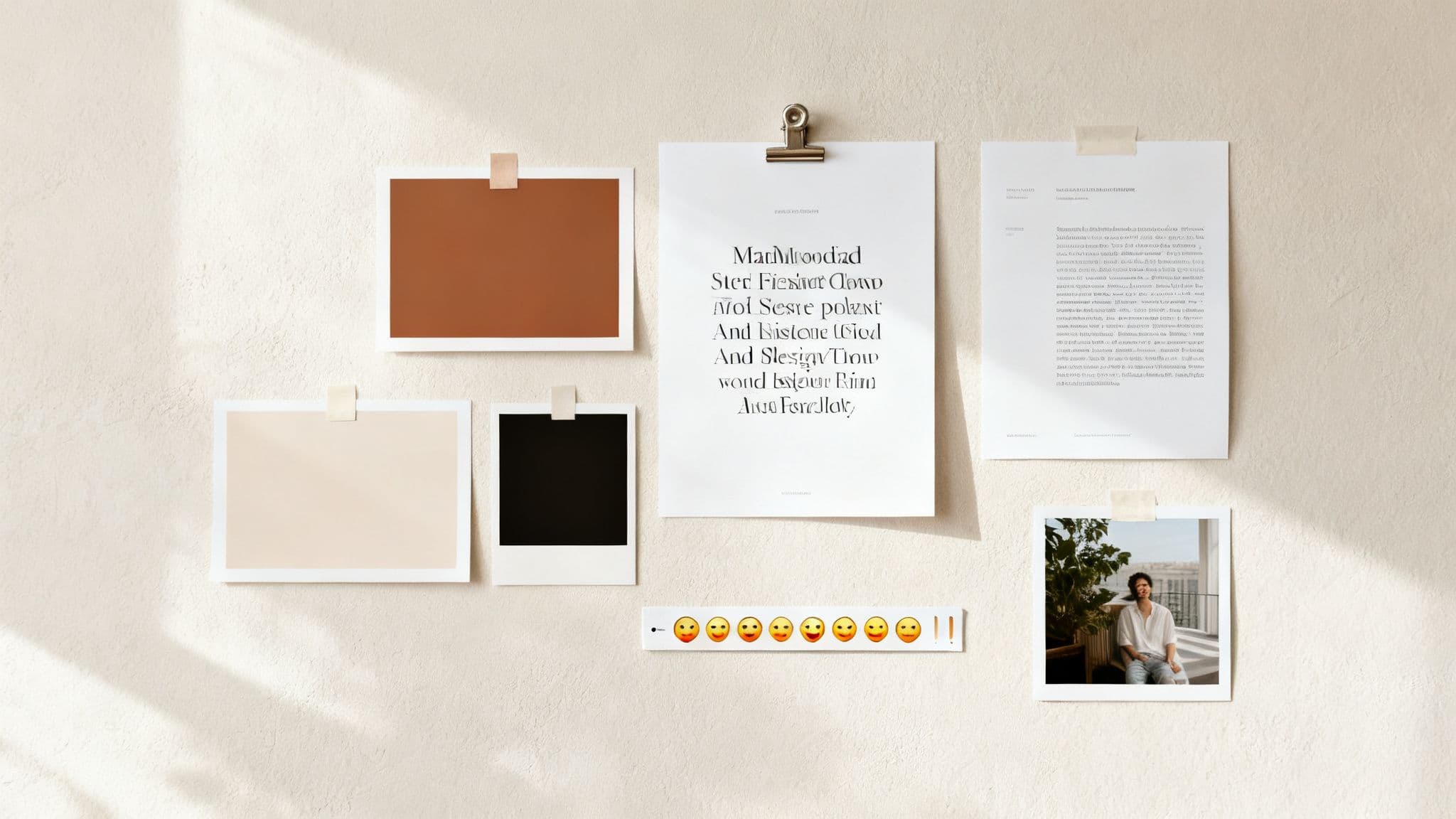
Look at Netflix's iconic red, black, and bold sans-serif font; it screams cinematic authority. Or consider MrBeast, whose high-contrast thumbnails, saturated colors, and bold text overlays create a sense of manic energy and urgency that perfectly matches his content. These aren't random choices; they are calculated visual cues that reinforce the core brand personality on platforms like TikTok and Instagram.
A strong visual identity acts as a container for your verbal voice. The most effective brand voice guidelines examples dedicate entire sections to visual rules, ensuring that every piece of content feels like it came from the same creative universe. This includes specific hex codes for colors, approved fonts for text overlays, and even rules on emoji usage (e.g., "Use ✨ and 💅, but never 😂").
Strategic Insight: Your visual identity should be a system, not a straitjacket. Establish 3-5 core visual patterns (e.g., a specific filter, a text-on-screen format, a recurring camera angle) that you can repeat. This creates consistency without making your feed feel stale or repetitive, which is key for keeping your audience engaged.
Ready to make your brand instantly recognizable? Here’s how to build your visual language.
By mastering the visual elements, you can elevate your content from just another post to a signature piece of your brand. Dive deeper into powerful visual storytelling techniques to learn how to make every frame count.
In a world of filters and perfectly curated feeds, audiences crave one thing above all else: realness. Authenticity and relatability standards are the guidelines that ensure your brand voice feels human, not like a corporate robot reading a script. It’s about striking the delicate balance between polished messaging and raw vulnerability, and it's the fastest way to build unbreakable trust with your community.
Think about Skims, where Kim Kardashian shares candid details about product development wins and failures, making customers feel like insiders. Or look at the countless TikTok creators whose unfiltered, "day-in-the-life" vlogs consistently outperform glossy, overproduced content. These brands understand that showing the process, admitting mistakes, and sharing the unedited moments is no longer a risk; it's a requirement for modern connection.
Genuine authenticity isn't about airing all your dirty laundry; it's a strategic decision about what to reveal and when. The best brand voice guidelines examples will create a framework for vulnerability. For instance, a wellness brand might specify: Share struggles with motivation, not personal medical advice; Show behind-the-scenes of a failed recipe, not a major business crisis. This creates guardrails that protect the brand while still fostering a human connection.
Strategic Insight: Your authenticity standard should define your brand’s version of real. For a luxury brand, it might be showing the painstaking craftsmanship of a product. For a creator, it could be an unfiltered Q&A about their journey. It doesn’t always mean messy; it just means true.
Ready to get real with your audience? Here’s how to build trust today.
A one-size-fits-all voice is a relic of the past. Your audience isn't a monolith, and your brand voice shouldn't be either. Smart guidelines define how your core personality adapts for different audience segments and platforms. This means the way you talk to your Gen Z audience on TikTok should feel different from how you engage with your millennial followers on Instagram, all while staying true to your brand's core identity.
Think of Nike: its core voice is aspirational and empowering. But on Instagram, it speaks to seasoned athletes with technical language, while on TikTok, it adopts a more inclusive, trend-forward tone to engage casual fitness fans. Similarly, Glossier nails this by using a nostalgic, slightly more polished voice on Instagram for its core millennial base, versus a raw, meme-heavy voice on TikTok to connect with Gen Z. It’s the same brand, just speaking different dialects.
The key is variation, not transformation. You're not creating entirely new personalities; you're just turning different dials up or down. The best brand voice guidelines examples map this out clearly, defining the subtle shifts in language, humor, and references for each key demographic and platform. This ensures your brand feels native to every space it occupies, rather than like a tourist awkwardly trying to fit in.
Strategic Insight: Your core brand values are the anchor. Before you adapt your voice, be crystal clear on what your brand stands for. For Nike, it's "athletic achievement." For Glossier, it's "beauty in real life." These core tenets should shine through whether you're posting a serious tutorial on YouTube or a silly duet on TikTok.
Ready to speak your audience’s language? Here’s how to do it without getting lost in translation.
If your brand voice is how you say things, your messaging pillars are what you consistently talk about. These are the 3-5 core themes that anchor all your content, ensuring that every post, no matter how trendy, ladders back up to your brand’s mission. It’s the difference between randomly posting content and building a cohesive narrative that your audience can rely on.
Think of Patagonia, which brilliantly revolves its content around pillars of environmental activism, product quality, and authentic outdoor culture. Or consider MrBeast, whose pillars of extreme generosity, epic challenges, and sheer entertainment value are unmistakable in every video. These pillars act as guardrails, keeping your content focused and reinforcing what you stand for.
Effective messaging pillars are the backbone of a strong content strategy. They prevent you from chasing every fleeting trend and instead help you filter which ones align with your core message. The best brand voice guidelines examples map out how these pillars come to life across different content formats, from quick TikToks to in-depth Instagram carousels.
Strategic Insight: Your messaging pillars shouldn't be restrictive; they should be a launchpad for creativity. A brand with a "sustainability" pillar can create content ranging from educational "how-to-upcycle" videos to behind-the-scenes footage of their eco-friendly packaging, all while staying on-brand. The pillar is the theme, but the execution can be infinitely varied.
Ready to build your content empire on a solid foundation? Here’s how to define and use your pillars.
Your brand voice isn't just about what you post; it's about how you show up in the DMs, the comment section, and the chaotic world of online chatter. Defining your conversational style and engagement protocols is how you turn passive followers into a loyal community. This is where you decide if you’re the brand that roasts competitors like Wendy's, the one that replies with heart emojis like Glossier, or the one that jumps on memes like Netflix. It’s the rulebook for building real relationships, one reply at a time.
Think of it as setting the rules of engagement for your digital party. Without clear guidelines, your comment section can become a free-for-all, with inconsistent replies that confuse your audience. A well-defined protocol ensures every team member, from the founder to a virtual assistant, knows exactly how to handle praise, field tough questions, and even deal with trolls, all while sounding perfectly on-brand.
Great engagement isn't random; it's strategic. The best brand voice guidelines examples for this area move beyond "be nice" and get into the specifics. They outline everything: approved emojis, response time goals (e.g., reply to all DMs within 12 hours), and even templates for frequently asked questions. For example, a protocol might specify using the ✨ and 💖 emojis for positive comments, but sticking to a professional and helpful tone for customer service issues. This level of detail prevents off-brand mishaps.
Strategic Insight: Your engagement protocol should be a living document that adapts to new platforms and trends. The way you reply on a fast-paced TikTok comment thread (quick, witty, emoji-heavy) will differ from a more detailed Instagram DM conversation. Define the core principles, but empower your team with the flexibility to adapt the execution.
Ready to turn your comment section into a community hub? Here’s how to do it.
A great brand voice isn't just about the words you choose; it’s about the stories you tell. Establishing clear storytelling structures gives your content a familiar, compelling rhythm that hooks viewers from the first second and keeps them watching. This guideline dictates how you build tension, present a conflict, and deliver a satisfying resolution, turning a simple video into a memorable narrative.

Think about the magnetic pull of a MrBeast video: it’s pure narrative genius. He presents an outrageous challenge (the hook), shows the struggle and attempts (the conflict), and delivers a clear win-or-lose outcome (the resolution). Similarly, skincare brands master the before-and-after transformation, a simple yet powerful story arc that makes the customer the hero. These aren't random posts; they are calculated stories built on proven frameworks.
The best brand voice guidelines examples include a playbook of core narrative arcs that can be adapted for any platform. Instead of reinventing the wheel for every post, you have proven templates ready to go. This ensures your content is consistently engaging and aligns with your brand’s mission, whether it's to inspire, educate, or entertain. Your brand becomes the guide, and your audience is the hero of the story you're telling.
Strategic Insight: Your story structure should make your audience the protagonist. Whether you're using a "Day in the Life" format or a problem-solution narrative, frame the content around a relatable struggle or goal that your viewer shares. This transforms passive consumption into active emotional investment.
Ready to become a master storyteller? Here's how to integrate narrative frameworks into your content strategy.
| Guideline | Implementation Complexity 🔄 | Resource Requirements ⚡ | Expected Outcomes ⭐📊 | Ideal Use Cases 💡 | Key Advantages ⭐ |
| Tone and Personality Definition | Medium 🔄🔄 — strategic alignment & examples | Low-Medium ⚡⚡ — workshops, documentation | High ⭐⭐ 📊 — recognition, trust | Brand identity setup; cross-platform voice | Immediate recognition; simplifies decisions; differentiates |
| Vocabulary and Language Preferences | Medium 🔄🔄 — glossary + review cadence | Low ⚡ — copy guidelines, SEO input | Medium-High ⭐ 📊 — clarity, SEO gains | Clear messaging; industry communications; SEO-led content | Ensures clarity; consistent messaging; prevents confusion |
| Visual Language and Design Consistency | High 🔄🔄🔄 — design systems & asset libraries | High ⚡⚡⚡ — designers, templates, production | High ⭐⭐ 📊 — strong aesthetic recognition | Visual platforms (IG, TikTok); product/brand refreshes | Recognizable aesthetic; enhances storytelling; trust |
| Authenticity and Relatability Standards | Medium 🔄🔄 — policies for vulnerability & BTS | Medium ⚡⚡ — creators, community engagement | High ⭐⭐ 📊 — deeper loyalty & organic reach | Community building; UGC; founder-led content | Builds trust; increases retention; differentiates from polished competitors |
| Audience Segmentation and Voice Variation | High 🔄🔄🔄 — personas + platform mapping | High ⚡⚡⚡ — research, analytics, tailored assets | High ⭐⭐ 📊 — relevance & conversion uplift | Multi-audience brands; platform-specific campaigns | Increases relevance; flexible consistency; better conversions |
| Messaging Pillars and Key Themes | Low-Medium 🔄🔄 — define 3–5 core pillars | Low ⚡ — workshops, content wheel | Medium-High ⭐ 📊 — coherent long-term narrative | Content planning; brand positioning; campaign backbone | Guides creators; strengthens positioning; consistent themes |
| Conversational Style and Engagement Protocols | Medium 🔄🔄 — response rules & templates | Medium-High ⚡⚡⚡ — community team, monitoring tools | High ⭐⭐ 📊 — engagement, insights, algorithm lift | Customer-facing social accounts; community management | Humanizes brand; drives engagement; gathers feedback |
| Storytelling Structure and Narrative Frameworks | Medium-High 🔄🔄🔄 — story templates & training | Medium ⚡⚡ — writers, editors, production time | High ⭐⭐ 📊 — higher retention and shareability | Short-form video, carousels, campaign storytelling | Increases engagement; improves completion rates; repeatable quality |
We've just gone on a deep dive, dissecting some of the most compelling brand voice guidelines examples from across the internet. We’ve seen how brands like Oatly use rebellious wit to build a cult following and how Headspace’s gentle, reassuring tone creates a sanctuary for its users. You now have a mental library of tactics, micro-templates for social captions, and a clearer vision for your own content.
The journey doesn't end with a perfectly crafted document. In fact, that's just the starting line. The real challenge, and where the most explosive growth happens, is in the daily execution. It’s about consistently translating those abstract guidelines into tangible, engaging content that stops the scroll and builds a loyal community.
Let's distill everything we've learned into a clear, actionable strategy. Think of this as your post-guideline cheat sheet for turning that brilliant voice into a powerful growth engine.
Having these guidelines is your creative compass. It ensures that no matter what you post, it feels authentically you. But a compass doesn't tell you where the gold is buried. For that, you need a treasure map. In the world of social media in 2026, that map is data.
To effectively turn your guidelines into growth, you also need to understand how to create brand guidelines that are practical and actionable in the first place. A well-structured document is the foundation. But once that's built, the next step is applying it strategically.
This is where most creators hit a wall. They spend hours scrolling the For You Page, trying to guess which trends fit their voice. They see a trending sound but aren't sure how to adapt it without sounding like everyone else. This guesswork leads to burnout and inconsistent results.
The solution isn't to post more; it's to post smarter. You need a system that bridges the gap between your unique brand voice and the trends that are actively capturing attention right now.
This is exactly why we built Trendy. It’s designed to be your personal content strategist. Instead of you hunting for trends, Trendy’s AI analyzes your niche, your audience, and the platform's algorithm to bring proven ideas directly to you. It surfaces trending audio, viral video formats, and provides ready-to-use hooks that you can easily adapt to your brand voice.
Imagine logging in and seeing a weekly content plan that says, "This sound is peaking in your niche. Here are three ways to use it that align with your 'quirky expert' voice." It removes the guesswork and frees you up to focus on what you do best: creating amazing content. Your brand voice guidelines give you the "how," and an intelligent tool like Trendy gives you the "what" and "when."
Stop guessing what will work and start creating with confidence. Trendy analyzes your niche and serves up a daily menu of proven content ideas, trending sounds, and viral hooks, so you can apply your killer brand voice to content that’s guaranteed to get seen. Download the app for iOS and Android and let AI become your new content strategy co-pilot. Learn more at Trendy.